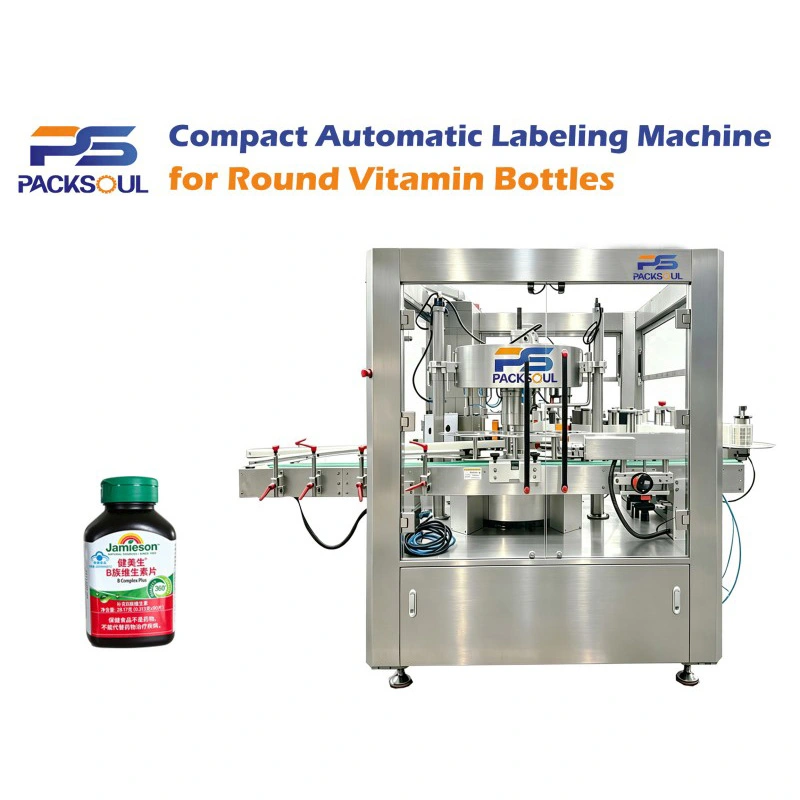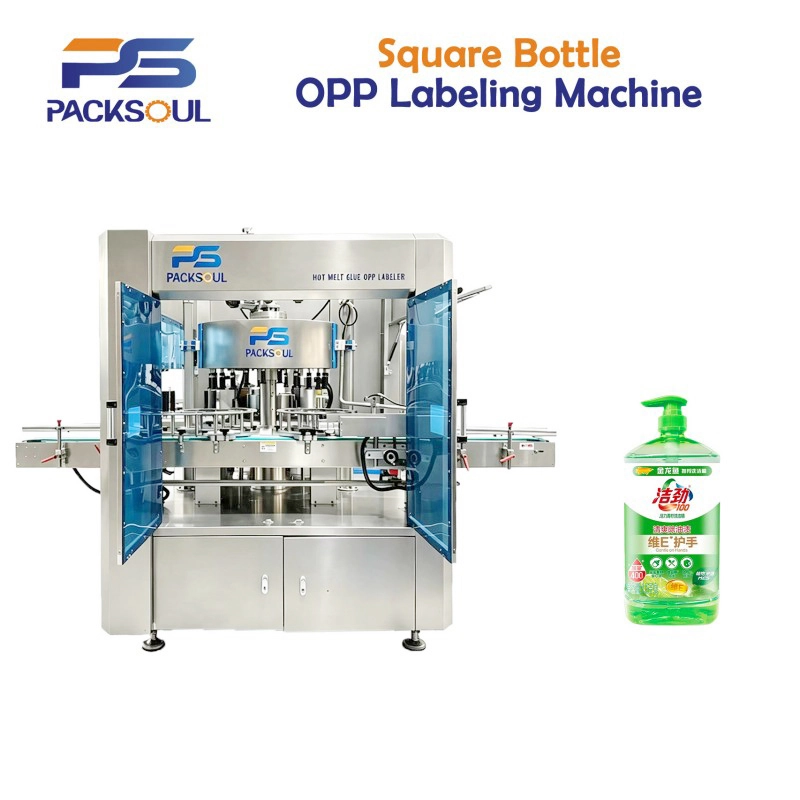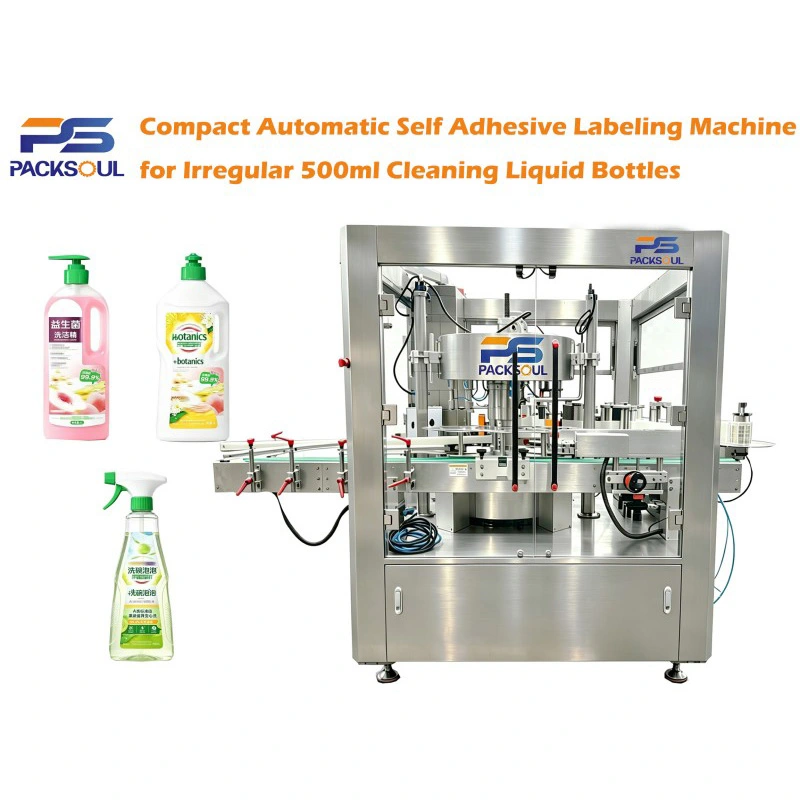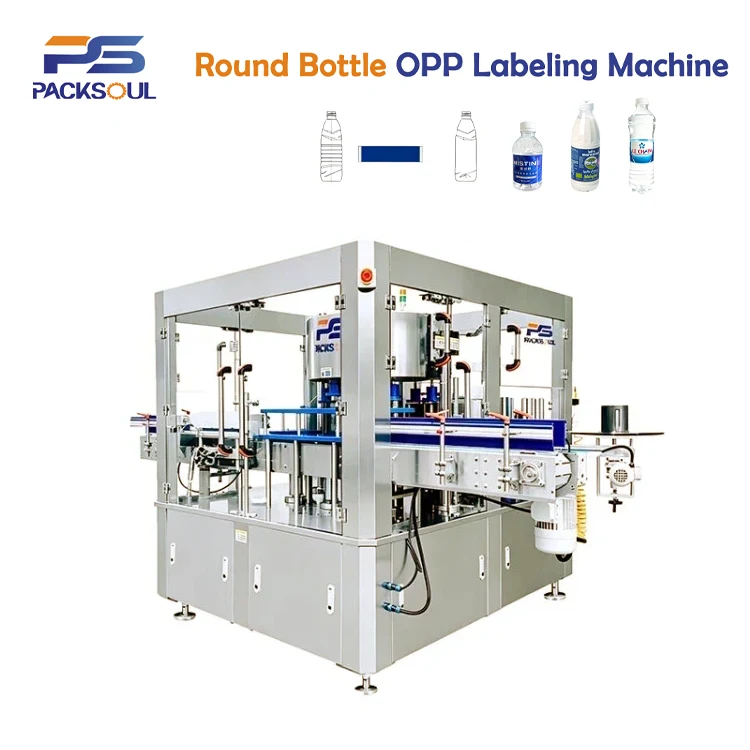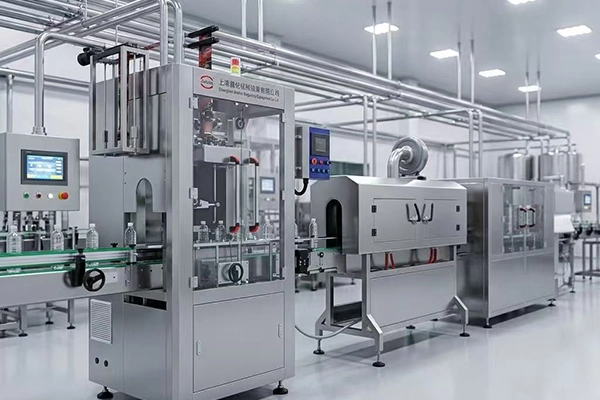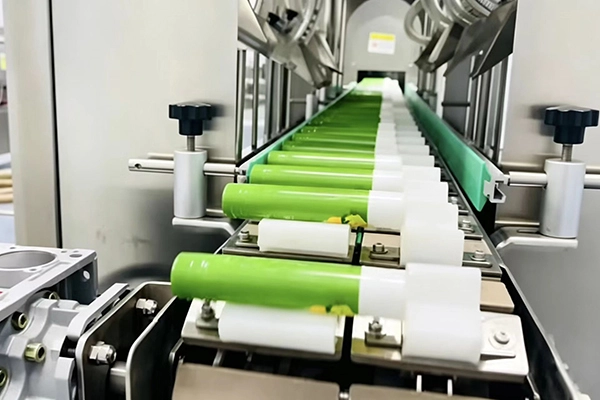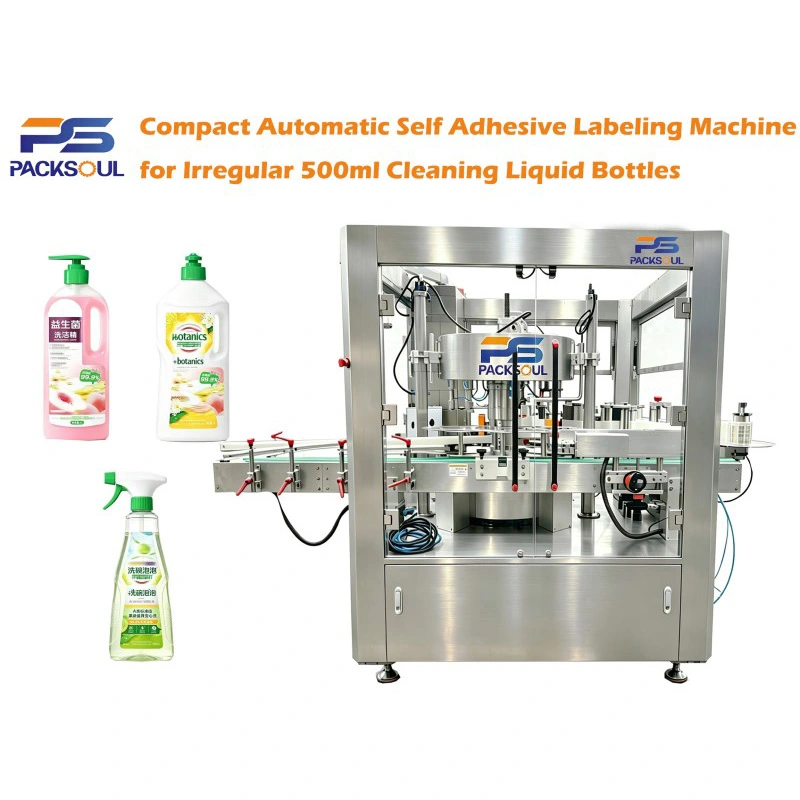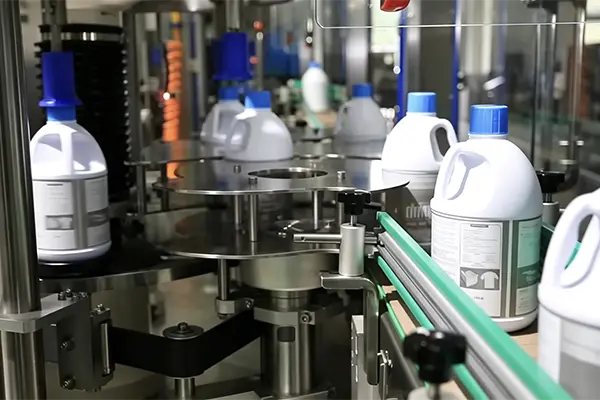
For cleaning product manufacturers handling shaped and handled containers, Packsoul offers the 500ml Irregular Cleaning Liquid Bottle Labeling Machine to automate bottle feeding, positioning, labeling, pressing, and discharge. Designed for 500–1000ml irregular cleaning liquid bottles, the machine combines servo-controlled label feeding, flexible bottle positioning, and pressure rollers to support stable, repeatable labeling in modern production environments.
Irregular cleaning liquid bottles can be difficult to label consistently because handles, curved surfaces, different bottle geometries, and unstable positioning may cause wrinkles, bubbles, label shifting, or bottle jams. An automatic labeling system designed specifically for these containers can address these challenges through controlled bottle positioning and synchronized label application. The Packsoul solution uses photoelectric detection, PLC control, servo label feeding, flexible guides, and shaped pressure components to improve labeling consistency. Its 304 stainless steel construction also supports the cleaning requirements of daily chemical production workshops. With adjustable configurations, single- or double-side labeling options, and the ability to connect with filling, capping, and coding equipment, it can serve both standalone and integrated production lines.
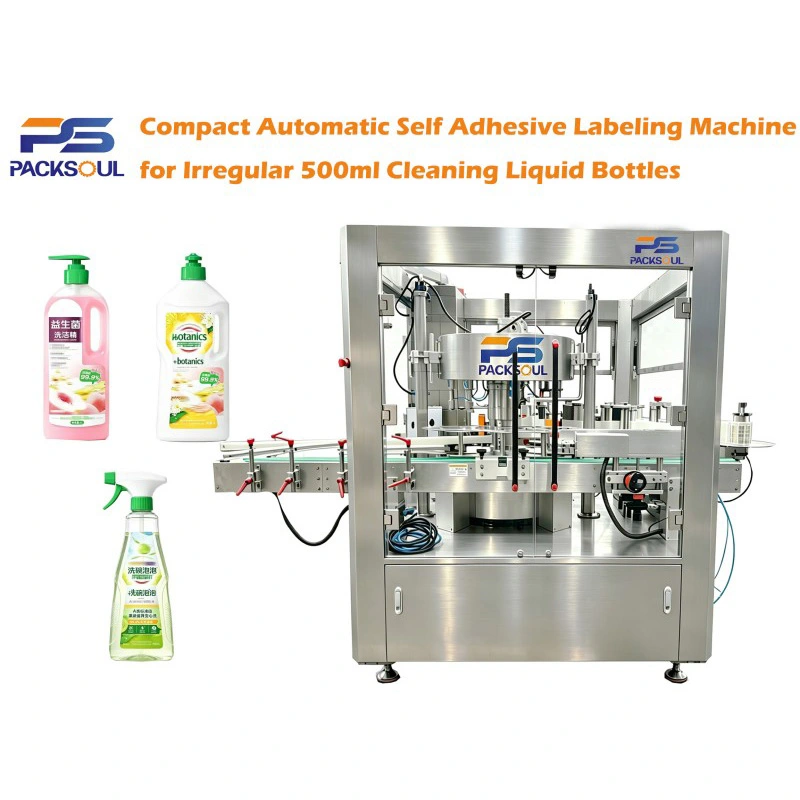
Table of Contents
- Why Is Irregular Bottle Labeling More Challenging?
- What Features Define an Effective Labeling Machine?
- How Does the 500ml Irregular Cleaning Liquid Bottle Labeling Machine Work?
- What Are the Main Technical Specifications?
- What Production Benefits Can Manufacturers Expect?
- How Are Machine Quality and Labeling Reliability Supported?
- How Should the Labeling Machine Be Maintained?
- Where Can This Machine Be Applied?
- What Should Buyers Consider Before Purchasing?
- FAQ About Irregular Cleaning Liquid Bottle Labeling
- Conclusion
Why Is Irregular Bottle Labeling More Challenging?
Standard round bottles generally provide a relatively predictable labeling surface. Cleaning products, however, frequently use bottles with handles, recessed areas, curved panels, asymmetric bodies, or other distinctive shapes. These designs can make conventional labeling methods less consistent.
During automatic production, an irregular bottle may rotate, tilt, or move away from the intended labeling position. At the same time, the label must follow a changing surface without trapping excessive air or creating wrinkles. A suitable labeling machine therefore needs to control both the container and the label rather than simply applying adhesive material at a fixed point.
A purpose-built system can help address common issues such as:
- Bottle movement during label application
- Label wrinkles and air bubbles
- Uneven label positioning
- Bottle jams around handles and irregular sections
- Inconsistent results during long production runs
- Manual labor associated with bottle positioning and labeling
What Features Define an Effective Labeling Machine?
The performance of an automatic labeling machine depends on how well its feeding, positioning, sensing, label dispensing, and pressing systems work together. For irregular cleaning liquid bottles, flexibility is particularly important.
Flexible Bottle Positioning
A flexible guide structure helps keep handled bottles in the intended position while they travel through the labeling station. This reduces the possibility of tipping and improves repeatability.
Servo-Controlled Label Feeding
Servo technology provides controlled label movement and stable tension. This helps synchronize label delivery with bottle movement and supports consistent application during continuous production.
PLC and Touch-Screen Operation
The PLC control system coordinates machine functions, while the touch screen allows operators to adjust production parameters and receive automatic fault alerts. This can simplify changeovers and routine operation.
304 Stainless Steel Construction
The machine body uses 304 stainless steel, which offers resistance to moisture and corrosion while making routine cleaning more convenient for daily chemical production environments.
Standalone or Line Integration
The equipment can operate independently or connect with upstream and downstream equipment such as filling, capping, and coding machines. This provides flexibility for manufacturers developing a complete automatic packaging line.
How Does the 500ml Irregular Cleaning Liquid Bottle Labeling Machine Work?
The labeling process combines automatic bottle detection, positioning, label feeding, and pressing. A typical operating sequence includes the following stages:
- Bottle feeding: The conveyor continuously transfers bottles toward the labeling section.
- Bottle separation: The feeding mechanism spaces bottles appropriately and helps correct their position.
- Rotary transfer: A customized transfer structure moves each container smoothly toward the labeling station.
- Bottle holding: A top holding system helps stabilize irregular handled bottles.
- Servo positioning: The servo system adjusts the bottle position and labeling angle.
- Label feeding: The self-adhesive label is dispensed under controlled tension and speed.
- Label pressing: Flexible brushes and pressure rollers follow the bottle surface and press the label firmly.
- Discharge: The finished bottle automatically moves to the next stage of production.
This coordinated process reduces dependence on manual positioning and creates a more repeatable labeling cycle.
What Are the Main Technical Specifications?
The referenced configuration uses an 8-station rotary adhesive sticker labeling system. The following specifications provide a practical overview for production planning:
| Parameter | Specification |
|---|---|
| Machine Type | 8-Station Rotary Adhesive Sticker Labeling Machine |
| Model | PSR-B080 |
| Labeling Speed | Up to 8,000 bottles/hour |
| Container Diameter | 30–100 mm, customizable for larger dimensions |
| Container Height | 100–400 mm |
| Maximum Label Height | 200 mm |
| Maximum Label Width | 300 mm |
| Label Roll Inner Diameter | 76 mm |
| Label Roll Outer Diameter | 400 mm |
| Machine Dimensions | 3000 × 2500 × 2000 mm |
| Power Supply | 380V / 50Hz / 14KW |
| Construction | 304 Stainless Steel |
Actual production performance depends on bottle geometry, label dimensions, material, adhesive characteristics, labeling configuration, and production-line conditions. Buyers should conduct sample testing before finalizing a configuration.
What Production Benefits Can Manufacturers Expect?
1. More Consistent Label Placement
Automatic positioning and servo-controlled label feeding help maintain repeatable label placement across large production batches. This is particularly useful when brand graphics, regulatory information, and product instructions must remain visually consistent.
2. Reduced Manual Labeling Work
Automating feeding, positioning, labeling, pressing, and discharge can reduce repetitive manual operations. Operators can instead focus on machine monitoring, material replenishment, quality checks, and production management.
3. Better Handling of Irregular Containers
Flexible guides and bottle-holding mechanisms are designed around the difficulties associated with handled and non-standard bottles. This can reduce interruptions caused by tipping, movement, and jams.
4. Easier Production-Line Integration
The machine can be used as an independent labeling unit or integrated with filling, capping, and coding equipment. This makes it suitable for manufacturers gradually upgrading from semi-automatic processes toward a complete automated line.
5. Efficient Use of Workshop Space
The compact design can be advantageous for small and medium-sized daily chemical production facilities where floor space must be allocated carefully among filling, capping, labeling, inspection, and packing equipment.
How Are Machine Quality and Labeling Reliability Supported?
Reliable automation depends on more than the machine's mechanical structure. Component selection, testing, commissioning, and after-sales support all influence long-term operation.
The referenced Packsoul configuration incorporates components from established industrial suppliers, including Schneider servo and PLC components, SICK detection sensors, LEUZE label sensors, and other industrial electrical components. The machine is also described as having CE and ISO 9001 certifications.
Before shipment, the equipment undergoes production inspection and a 24-hour aging test. Customer bottle samples can also be used for testing so that the labeling configuration can be evaluated against the actual container design.
For international buyers, this sample-based approach is particularly useful because bottle dimensions, label materials, adhesive behavior, and production requirements can vary significantly between applications.
How Should the Labeling Machine Be Maintained?
Routine maintenance helps preserve labeling accuracy and reduce avoidable downtime. A practical maintenance program should include:
- Cleaning adhesive residue and dust from pressure rollers.
- Keeping the machine body and conveyor area clean.
- Checking and wiping photoelectric sensors regularly.
- Inspecting moving parts and lubricating them when required.
- Checking fasteners and tightening loose screws.
- Inspecting the servo system and electrical control cabinet.
- Checking labeling accuracy after major adjustments or product changes.
- Keeping commonly required spare and consumable parts available.
Operators should also follow the machine manual and maintenance schedule supplied with the specific configuration.
Where Can This Machine Be Applied?
The primary application is the automatic labeling of irregular cleaning product bottles. Typical products and production environments may include:
- Household cleaning liquids
- Dishwashing liquids
- Daily chemical products
- Handled plastic cleaning bottles
- Irregular-shape liquid containers
- Home-care and personal-care packaging lines
Because bottle dimensions and shapes can differ considerably, manufacturers should provide actual samples when requesting a customized labeling solution. Bottle samples allow engineers to assess positioning, label placement, pressure requirements, and line compatibility more accurately.
What Should Buyers Consider Before Purchasing?
Selecting a labeling machine should begin with the application rather than simply the advertised machine speed. A buyer should evaluate the complete relationship between the container, label, production target, and existing packaging line.
Key information to prepare
- Bottle dimensions and material
- Photos or physical samples of the irregular bottle
- Whether the bottle has a handle, recess, or curved labeling surface
- Label dimensions and material
- Required labeling position
- Single-side or double-side labeling requirements
- Target bottles per hour
- Available workshop space
- Existing filling, capping, coding, and conveyor equipment
- Required electrical specifications
For buyers comparing an irregular shape bottle labeling machine with a standard round-bottle model, the most important consideration is container compatibility. A machine optimized for irregular containers can provide the positioning flexibility required by shaped cleaning bottles.
FAQ About Irregular Cleaning Liquid Bottle Labeling
Q1: Will bubbles or wrinkles appear when labeling handled 500ml irregular cleaning bottles?
A servo constant-tension labeling system combined with shaped pressure rollers is designed to help remove air during application and reduce bubbles, wrinkles, and label misalignment. Actual results depend on the bottle surface and label material.
Q2: Can the machine be customized for a specific cleaning bottle?
Yes. Custom configurations can be developed according to bottle shape, label specifications, production capacity, and workshop conditions. Providing bottle and label samples is recommended for accurate engineering evaluation.
Q3: Can it be connected to a complete filling line?
Yes. The labeling machine can operate independently or be connected with filling, capping, coding, and other packaging equipment to form a continuous production line.
Q4: What is the typical delivery time?
Standard machines generally require approximately 30–60 days. Customized machine delivery schedules are confirmed according to the final technical configuration and contract.
Q5: Is overseas installation and technical support available?
Yes. On-site installation and commissioning can be arranged when required. Operation training, Chinese and English manuals, remote technical assistance, and long-term maintenance support are also available.
Q6: What information should I provide for a machine quotation?
Provide the bottle dimensions or sample, label size and material, required labeling position, target output, workshop conditions, and details of any existing production-line equipment. This information helps engineers recommend an appropriate configuration.
Conclusion
The 500ml Irregular Cleaning Liquid Bottle Labeling Machine addresses a specific automation challenge: applying labels consistently to handled and irregular cleaning liquid containers. Its combination of bottle positioning, photoelectric detection, PLC control, servo label feeding, flexible guides, and pressure rollers provides a structured approach to improving labeling consistency and production efficiency. For manufacturers planning a new packaging line or upgrading an existing operation, evaluating the actual bottle and label samples is an important step toward selecting the right configuration. If you are planning to automate your cleaning liquid packaging process, share your bottle specifications, label requirements, and target production capacity with Packsoul and contact us for a suitable labeling solution and technical recommendation.